
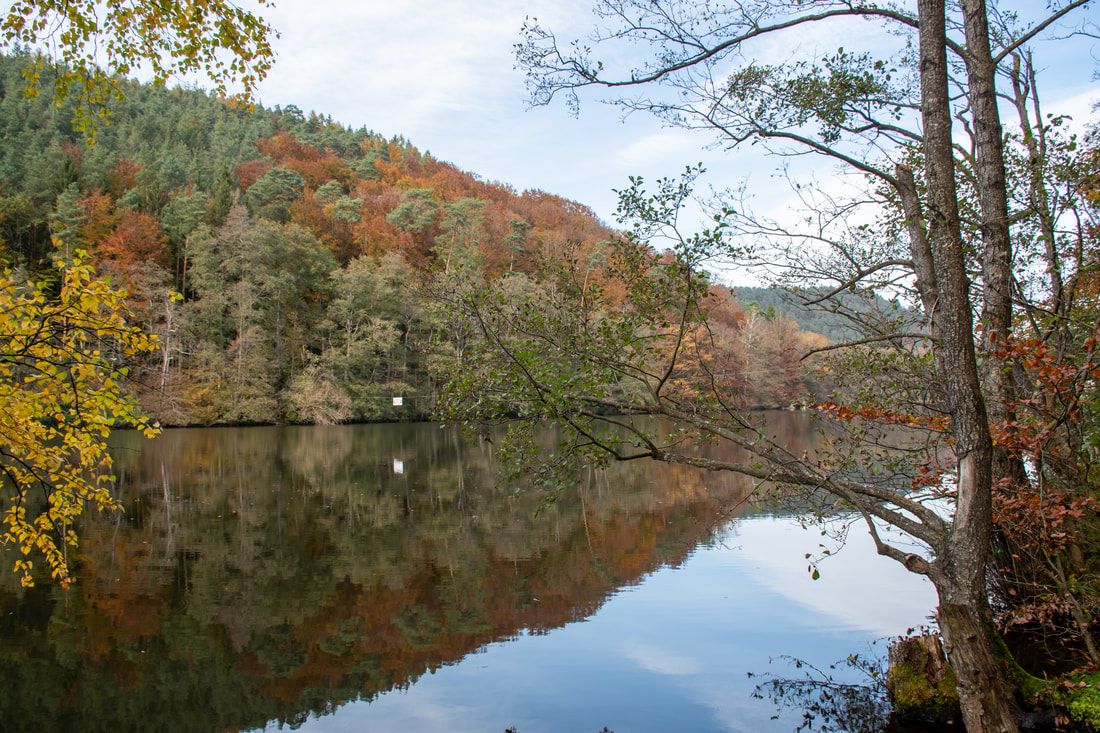
 German Forest and Lake. I have often written about my own personal process with regards to “not taking things personally”. Recently, when I had a session with my mentor and supervisor, there was another layer that emerged from that. Even though I understood the collapse of the internal boundary beforehand, which is essentially what “taking things personally” is, I experienced deeper layers underneath that; feelings that I distanced myself from. I had been frequently working with my mentor on staying in my body without interpreting sensations or coming to conclusions too quickly. I often felt criticised when she guided me back to my body, as I really wanted her to listen to what I had to say or what insights I had in that moment. I perceived her guiding me back as a judgement, even though objectively I understood that she was coming from a very neutral, allowing and kind place.
I interpreted her intentions and directions as “I’m not enough”, “I’m not doing this right” and “I should be somehow different”. In those moments, my heart was pounding and I felt very exposed and vulnerable. I could feel the increased blood flow to my face, a sign of feeling ashamed. My last session with her was a real breakthrough for me, as I could stay with the physical sensations and discovered the huge amount of fear in my system, which I often override or don’t acknowledge. My go to place has been anger, fight or action. In that moment, I could sit with my helplessness, which touched into very young places inside of myself. Even though it was uncomfortable, it was manageable and the energy eventually got processed and moved. I feel the moment I moved beyond the “taking things personally”, I could really be with the emotion of fear, ultimately evoking a deep shift inside of myself. What are the emotions you tend to distance yourself from?
0 Comments
 For me, personally, the gifts of the pandemic have been the online trainings I have been able to attend for the last 18 months. Whereas before the pandemic, I would have needed to travel at least within Europe, I can now take some further education from home via the internet. This has enabled me to connect to colleagues from around the globe, from America, to South America, Europe and Asia, which has been a truly touching and enriching experience. Last weekend I had the privilege to attend a four day CPD with Ditte Marcher, senior teacher in the Bodynamic system, which is a form of body psychotherapy looking at the psychological potential of muscles in distinct developmental stages.
One of my most important learnings from that training, which was about attachment, bonding and connectedness, was the distinction between asking for support versus making demands. It’s the distinction between seeking safety together with another person vs. seeking safety through the other person. When I’m asking for support, I’m taking responsibility for my own needs; when I’m making demands, I’m asking the other person to fulfil my needs and become responsible for my happiness, well-being, safety, etc. Ultimately, we’re dependent on one another and being self-sufficient is an illusion. However, it’s not the responsibility of other to fulfil our needs; it’s our own responsibility. Taking responsibility for our own needs, including safety, does not mean we can do it by ourselves. Most of us need to learn to ask for support and then to take it in when it’s offered. If someone can’t support us or does not give us what we need, we don’t lose our right to support and safety, it simply means we might have to re-orient. When was the last time you made someone else responsible for your safety, happiness or well-being instead of owning it yourself? 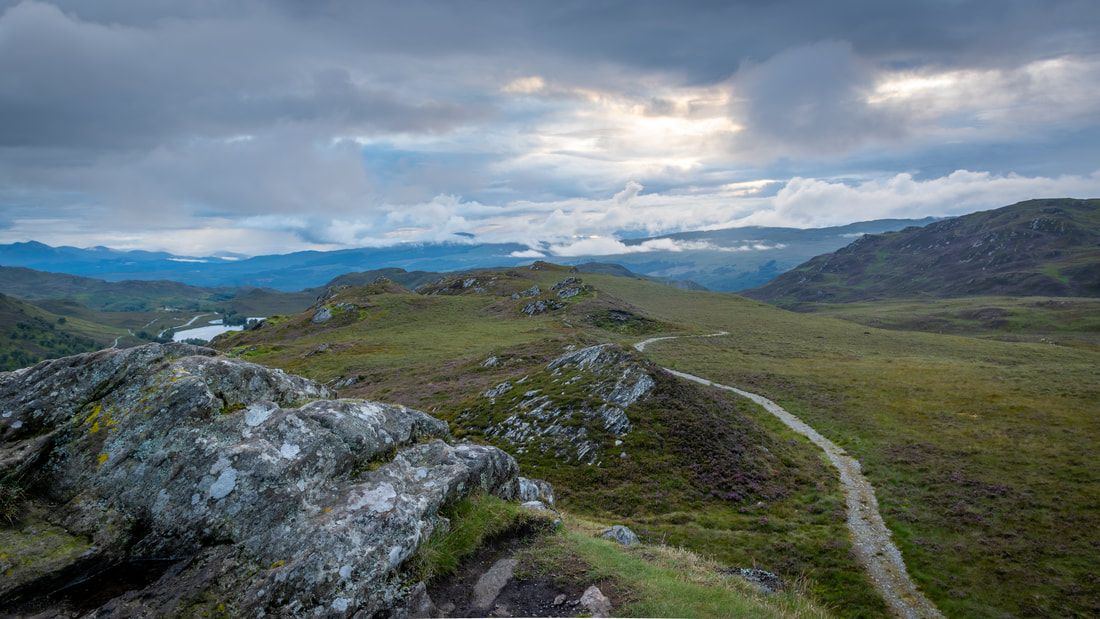 For our summer holidays, Brian and I went to Scotland for a week. We took our mountain bikes and planned a couple of routes. The first ride around Aviemore was long, but beautiful and classed as “super easy” from a mountain bike perspective. The second trip near Torridon, even though apparently in the “all skill level” category, according to my app, turned out very differently…
It started off easy with a wide dirt road around a beautiful loch, which turned into an interesting muddy single track, which then moved into a gravel road that was super steep and then it stopped… The following two and a half hours were very insightful, painful and inspirational all at the same time. The scenery was stunning, it was very remote and there was not a single person in sight. However, we had to push the bike up the hill! I had never heard of the term “hike a bike” and was introduced to this concept on an experiential level right there. Normally you would carry your light weight mountain up the hill. Mine, a definitely more economical version, weighed so much, that carrying it up the hill was out of the question. So we pushed and lifted; and pushed and lifted over rocks and through streams. We averaged 3 km/h !!! After 30 minutes of exhausting exercise, I realised that the remaining 8 kilometres would not be any different. After I understood that and also felt that there was no point in blaming anybody, something really interesting shifted inside of me. Peace and a very deep rooted acceptance of the situation emerged. We had enough daylight, and even though we did not have enough water, I had made the decision that it was safe to drink out of the stream - and it was (after some small doubts that came after I drank the water…). I was grateful for every inch we could ride, even though there were few. At the same time, I surrendered to the fact that it was tough. I was elated when we reached the top, even though we could not ride down either…. The steep descent, including rock gardens, wore my brakes out, but somehow even the crossing of a river could not detract from my inner peace. There were moments where I thought I could not do it and it was exhausting, but there was absolutely no chatter in my mind and I somehow managed to tap into a pool of inner resources and guidance that I did not know I had. It was a truly magical experience, even though outright dangerous at times. I liked the person I found within myself when I pushed the bike up the mountain; a person that can dig deep and find some strength from nowhere; a person that was at peace. I very much feel that this is within all of us. In those moments when we think we cannot do it, when we feel we had enough or want to give up, there is something else that can come in and support us. Let it.  The pandemic has been an invitation for myself to reflect on the vision I have been having for Equilibrium. When I left the software company I was working for in 2006 – at the age of 27 – I told my work colleagues that I would be opening a yoga centre. There were only a few who did not think I was a little crazy.
Opening the studio in Peterborough was definitely not an easy birth and I’m pleased that I did not really know what was involved in starting a business. The building works took longer, were more expensive and we encountered problems along the way which we did not know existed. When Brian, my now husband, and I opened Huntingdon in 2011 and we encountered some of the same problems, even though in a much milder form, he could not understand that I had agreed to opening a second centre having experienced the horrendous birthing pains in Peterborough. I guess… one forgets. The vision for Equilibrium has always been about an interdisciplinary approach where a community of practitioners, clients, teachers and therapists can come together to create something bigger than the sum of the individual parts. It was always meant to be a place of growth, exploration, healing and a space to simply be. For me, it has always been about the physical space and the energy that gets created when we are together in a room. I loved the first yoga studio I went to in Edinburgh in 1999, which has been a huge inspiration for Equilibrium. And at its core, the vision is the same: it’s about creating balance. I feel that this is more current than ever. I can see so much polarisation around me. I hope as a centre we can strive for balance and come into equilibrium:
My vision is that Equilibrium can create a great balance within the team of teachers and therapists, in what we deliver, the people we attract and the space we create.  One of my teachers in the body psychotherapy world often talks about group dynamics and how we relate to people. She describes two relational systems: dominance/submission and the supportive companionable. The first way of relating is comparing ourselves to others in the group and start to feel inferior or superior. In other words, we go “one down” or “one up”. The other way of relating is to move into the “supportive companionable” where we can relate as equals – no matter what functional role we are occupying. When we are in the “less than” space we often experience powerlessness. In body psychotherapy terms: we lose our inner authority. In that moment, we sense that we don’t have a choice. We feel that things are happening “to” us and that we don’t have an impact on our environment. To work with trauma and stress it’s crucial that we get out of the patterns of dominance (thinking too much of ourselves) and submission (thinking too little of ourselves) and move towards the supportive companionable.
The current situation is stress inducing, can be potentially traumatic and I have been tracking in myself that occasionally I’m moving into the one down position. In those moments I feel things are done to me and the world is unfair. When I’m stopping and recognising that I have choices, albeit sometimes not great ones, I can reclaim my inner power and take charge of making things work for me, which is a crucial aspect in moving through the current difficulties in a healthy way. To maintain inner authority, it’s pivotal that we take small breaks, sense into how we are, slow down and integrate our experiences. We need to take charge of making things work for us. The inner feeling of being in charge gets diminished when we just “suck it up and get on with things". When do you lose your sense of inner authority? What is it like in your body? Where do you collapse? What choices do you actually have?  Projections. Stories. Reality. For Christmas I was a gifted the book of “The Midnight Library", which I've found a very inspirational and thought provoking read. In this novel, the philosopher Thoreau is named and quoted numerous times. One quote in particular made me stop and reflect:
"It's not what you look at that matters, it's what you see." (Henry David Thoreau) I've been contemplating a lot about projections, how we view the world and how our narrative shapes our reality. It's interesting to observe in myself what story I put onto a one-liner email, how I interpret a facebook post or what I read into a simple text message. Ultimately, I'm restricting myself and closing opportunities that are there, but I can't perceive as such. My intent is definitely to catch those moments when I'm filling in the gaps with all sorts of speculations that are neither helpful nor true and then to stay present with what really is vs. my wild interpretation of it. I'm wishing you a happy new year 2021 where we hopefully can distinguish a little bit more between what we look at and what we see. And maybe there is space to see things and situations differently.  Gestation Part of my supervision is to reflect on my own process and how it is moving through me. The word that came up recently during one of my sessions is “gestation”, which medically means the period of maturation inside the womb from conception to birth. More generally, it’s about the development of something over a period of time. The normal limits of the human gestation period are from 37 to 42 weeks. It has now been about 34 weeks since the start of the first lockdown and in myself I get the sense that something new will be born in the near future. Since March of this year I’ve completed one of the biggest projects of my life (UKCP registration as a psychotherapist), I let go of a role that I had been holding for the last eight years within the Forrest Yoga community and of course I have stopped travelling completely, which brought about a huge change in the way I deliver my work. I have felt that there has been a true integration within myself of the different passions I have: yoga and body psychotherapy. For me, it’s culminating in a two day training I will be teaching online at the end of the month where I’m bringing together different aspects of my work. In some way, I’m being more un-apologetically me in my work.
What has been developing within you? What new beginnings are lurking around the corner for you? What are you giving birth to?  Watching a recent video on you tube with Lisbeth and Ditte Marcher, I was struck by the notion of “Justice does not exist”, i.e. things are unfair at times. We develop a sense of just and unjust between the ages of 2 and 4 years old. It’s the time the child learns to make decisions and how to choose. The understanding of duality, such as good and bad, is being developed then. During that time, the ability to understand consequences is also established. In the video, both women make clear that choosing something means letting go of something else. In order to make decisions we need to fully embrace the consequences of that decision, including the fact that things might not be fair. We can get stuck in that developmental phase thinking that things are either black or white, fair or not fair. Subsequently, we have difficulties making decisions, because in reality there are no perfect choices. Sometimes the decision is between pest and cholera.
I, personally, feel that this has so much relevance right now. My sense is that we really need to let go of the notion of justice and be real that we have choices, but that they might not be fantastically great. Where do you get trapped when making decisions? What happens within you when you get stuck in the position of “The world is unfair?”.  In one of the sessions with my client, the word autonomy came up, which I have been reflecting on since. In Bodynamic, which is a form of body psychotherapy, the stage of autonomy is a developmental phase from 8 months to 2.5 years. It’s the time where we learn to keep our impulses whilst being in relationship. The question is “Who am I when in contact with another?”. One of the risks we are running is that we lose ourselves in the relationship. The challenge is to stay in contact with our own centre, power and feelings whilst being in relationship with another human being. It’s about an open heart without needing to shut down or abandon ourselves.
I invite you to track when you lose connection to yourself, when you start to follow another person’s rhythm, pace and timing, thereby losing your own and when you give your power away in order to stay in contact.  Sometimes a week or days can be summarised by or explored through one word. For this and last week, this word has been "discernment" for me. It has come up for me in a session with my supervisor, who has trained in and taught a psychotherapeutic tradition that is based on Buddhism. One of the definition of discernment (not in the Buddhist sense, but in the broader sense) is "the quality of being able to grasp and comprehend what is obscure" (Merriam Webster Dictionary). Other definitions include words like insight and being able to judge well and accurately. A lot of the work I have been doing is about understanding what is my real and authentic self and where am I stuck in my patterns. Sometimes being triggered, or in transference, can feel like reality. However, I know that when I take my time and importantly slow down, I can distinguish, i.e. discern, between my defences and coping mechanism and my real self, i.e. between what is the immediate and real experience and what I have fallen into, unconsciously.
For me personally, when I'm in my pattern, there is a sense of urgency to do something, a feeling of not wanting to be with what is emerging and a desire to discharge the overwhelming emotions. This is often accompanied with a lack of grounding and thoughts that are in a constant loop. On the other hand, when I'm in contact with my authentic self and what is truly emerging within me vs. the secondary more interpretative energies that are often layered on top, I'm more centred, more grounded and slower. I am in contact with my centre and with what is real. The art is to discern: what is real and what is made up; what is coming from the core and what is story. Walk in beauty. Sandra |
BlogYoga, well-being and mindfulness... always walk in beauty. Categories
All
Archives
October 2026
|
 RSS Feed